|
Analog Sources
Cartridges moving coil only. Tonearms are long with excessive affective mass. A few cartridges with different profile needles are good. Whatever turntable used it should not produce the disgusting “ported” bass with hollow tone – the 99% of them do. I prefer very heavy TT with high inertia driven by low torque belts. Whatever type or topology phonocorrector is used it shall give out more gain then needed. The RLC RIAA is better than RC. No records treatment of any kind beside regular washing with alcoholic flue and vacuuming. No cable after step-up transformer, if a transformer is used. No contemporary LP pressing – they are all garbage.
Digital Sources
SACD, DVD-A, XRCD and many other “hi-resolution” formats should not be used. Properly implemented 20-24bit PCM is way more musical than anything else so far commercially supported. Digital is inherently not editable. A RAW 24bit file, right after A/D processor is true pure digital. If the file was expose to ANY further DSP processing, even change 0.1dB of gains is a terminal death of pure digital and birth of digital garbage. Any rate, resolution or format conversion, including putting the file to CD, DVD formats, is terminally killing the file.
Amplification Electronics
An amplifier has to have minimum amount of stages to serve the needed of the given gain. I am an advocate of DSET topology - Dedicated Single-Ended Triode™, The concept DSET implies a narrow-bandwidth parallel operation of the SET channels with an optimization of transformers, operation point, power supplies and other parameters specificity for the needs of the given bandwidths. I advocate no active crossovering around active stages but line-level crossovering integrated with DSET topology.
Loudspeakers
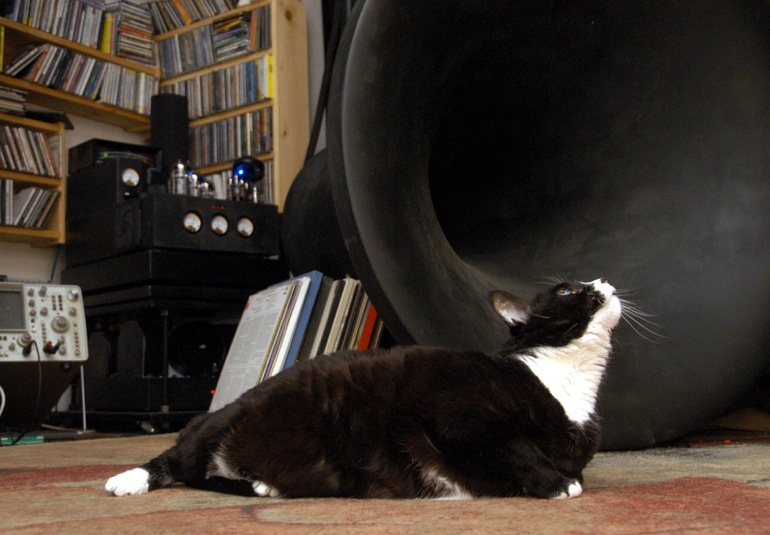
No ports. No dipolar operation in any forms. No synthetic driver’s cones. Wider dynamic range is better but after 110dB/W the Transient/Tone balance rapidly goes down. No impedance equalization, no resonators of any kind. No crossovers more then 6db/octave if possible; in very specific cases higher order might be used but very reservingly, very “creatively” and with the very well-determined purpose. Loudspeakers should have multiple channels and the channel should be painstakingly and meticulously time-aligned not only geometrically but acoustically. Any minute phase discrepancy between the channels religiously tabooed. Loudspeakers should be viewed only in context of their listening environment and should be positioned according the DPoLS concept (search my site for further explanations). The “quality” of the loudspeakers should bear ONLY on the quality of drivers and the loudspeaker design should recognize and to embrace (not combat!) the idiosyncrasies of drivers. Consequentially the design should furnish the best possible environment for the drivers to let them operate at their full natural blossom. Horn loaded loudspeakers are the most advance topology of any loudspeaker. The properly implemented and advanced performing home-based horn-loaded loudspeakers are practically unknown to wide audio public.
They were my very basic principles. If you do not like them then I have others....
|